

If you’ve ever rolled out of bed with stiff shoulders, caught your reflection hunched over a keyboard, or felt that nagging tightness across your upper chest after a long drive — your pectorals are talking to you. The question is: are you listening?
The pec stretch is one of the most overlooked tools in the recovery and mobility toolkit. It’s not glamorous. It won’t make your Instagram feed. But done consistently, it can reverse years of postural damage, relieve shoulder tension, and help you move and breathe with more ease than you have in years.
Let’s break it all down — what the pecs actually are, why they get so tight, and the best stretches to open them back up.
What Is the Pec Stretch?
A pec stretch — short for pectoralis stretch — is any movement that lengthens the muscles across the front of your chest. The primary targets are:
- Pectoralis major — the large, fan-shaped muscle spanning your chest from your collarbone and sternum to your upper arm
- Pectoralis minor — a smaller, deeper muscle connecting your ribs to your shoulder blade (scapula)
- Anterior deltoid — the front portion of your shoulder, often pulled tight along with the pecs
- Biceps brachii — the upper arm muscle that also gets dragged into this pattern of tightness
When these muscles shorten and stiffen, your shoulders round forward, your upper back curves into a hunch, and normal arm movements start feeling restricted. Chest stretches directly counteract this by pulling those muscles back into their natural, elongated position.
Why Do Your Pecs Get So Tight?
Modern life is essentially a recipe for chest tightness. Think about your day: typing at a desk, scrolling a phone, driving, cooking, carrying groceries, holding a baby. Nearly all of it happens in front of your body, with your arms pulled inward and your chest collapsed slightly forward.
Over time, the muscles adapt to this position. They shorten. They stop reminding you they exist — until you reach for something overhead and suddenly they make themselves very known.
Athletes are not immune. Swimmers, cyclists, rowers, and weightlifters who focus heavily on pushing movements (bench press, push-ups, dips) all develop powerful but often very tight pec muscles if they don’t balance that work with deliberate stretching.
The result of chronically tight pectorals is a condition called anterior shoulder rounding — where the natural architecture of your upper body collapses inward. This limits the range of motion in the shoulder joint, increases wear on the rotator cuff, contributes to neck pain, and even affects your breathing by compressing the chest cavity.
The fix? Consistent, targeted pec stretching.
How to Stretch Your Pecs Effectively
Before diving into specific stretches, a few principles worth keeping in mind:
Duration matters. Hold each stretch for 20–40 seconds. Muscle tissue needs time to respond to a sustained lengthening signal — quick passes don’t do much.
Breathe into the stretch. On each exhale, allow your chest to soften and your shoulders to drop back a little further. Breath is your most underused stretching tool.
No bouncing. Ballistic movement in a stretch triggers the stretch reflex — your muscle contracts to protect itself, which is the opposite of what you want. Move slowly, hold steadily.
Repeat each stretch 2–3 times. A single pass rarely creates lasting change. Multiple rounds of the same stretch compound the effect.
Focus on the shoulder blades. In almost every chest stretch, the cue is the same: draw your shoulder blades together and down, and let your chest lift and open forward. This activates the opposing muscles (mid-back, lower traps) while creating space in the front.
6 Pec Stretches That Actually Work
1. Standing Doorway Chest Opener
This is the classic — and for good reason. A doorway gives you a fixed anchor point and lets you stretch both sides simultaneously or one at a time.
Stand in the center of a doorway. Raise both arms to shoulder height, bend your elbows to 90 degrees, and place your forearms against the door frame on each side. Step one foot forward into the doorway and gently lean your chest through the opening. You should feel an immediate stretch across the front of both shoulders and your chest.
Variation: Move your arms slightly higher (above 90 degrees) to target the lower fibers of the pec major. Move them slightly lower to hit the clavicular (upper) fibers.
2. Single-Arm Wall Stretch
This variation lets you work each side independently, which is useful because most people have more tightness on one side than the other.
Stand beside a wall. Extend one arm and press your palm flat against the surface at shoulder height, fingers pointing backward. Keeping your arm straight, slowly rotate your entire body away from the wall until you feel a stretch running from your chest into your shoulder and upper arm.
Hold, breathe, and then try tilting your head slightly away from the stretched side for an added stretch into the scalene muscles of the neck.
3. Behind-the-Back Hand Clasp
No wall, no door frame needed — this one is fully portable and can be done seated or standing, making it ideal for office breaks or travel.
Sit or stand tall. Bring both arms behind your back and clasp your hands together, interlacing the fingers. Straighten your arms, squeeze your shoulder blades together, and lift your clasped hands slightly upward while pressing your chest forward and upward.
If your hands don’t reach each other, use a strap, towel, or belt to bridge the gap. The goal is the motion — opening the chest — not forcing a connection behind your back.
4. Overhead Interlaced Fingers Stretch
Targeting the upper fibers of the pectoralis major and the anterior deltoid, this stretch also opens the often-neglected region just beneath the collarbones.
Interlace your fingers and press your palms toward the ceiling, arms fully extended overhead. Keep your ribs down (avoid flaring them up) and think of reaching tall through your fingertips while sliding your shoulder blades down your back. Gently lean back just a few degrees to increase the stretch across your chest.
Breathe slowly. With each inhale, feel your chest expand. With each exhale, let your shoulders soften further back and down.
5. Foam Roller Thoracic Extension
This one does double duty — it stretches the pecs while simultaneously mobilizing the thoracic spine (mid-back), which is often just as restricted.
Place a foam roller perpendicular to your spine, roughly at mid-back level. Sit on the floor in front of it, then lean back over the roller, supporting your head with your hands interlaced behind your neck. Let your chest open toward the ceiling and your elbows fall wide.
You can stay stationary for a passive stretch or gently extend and flex over the roller to work through multiple thoracic segments. This is one of the most effective chest openers available, especially for people with significant thoracic kyphosis (excessive rounding of the upper back).
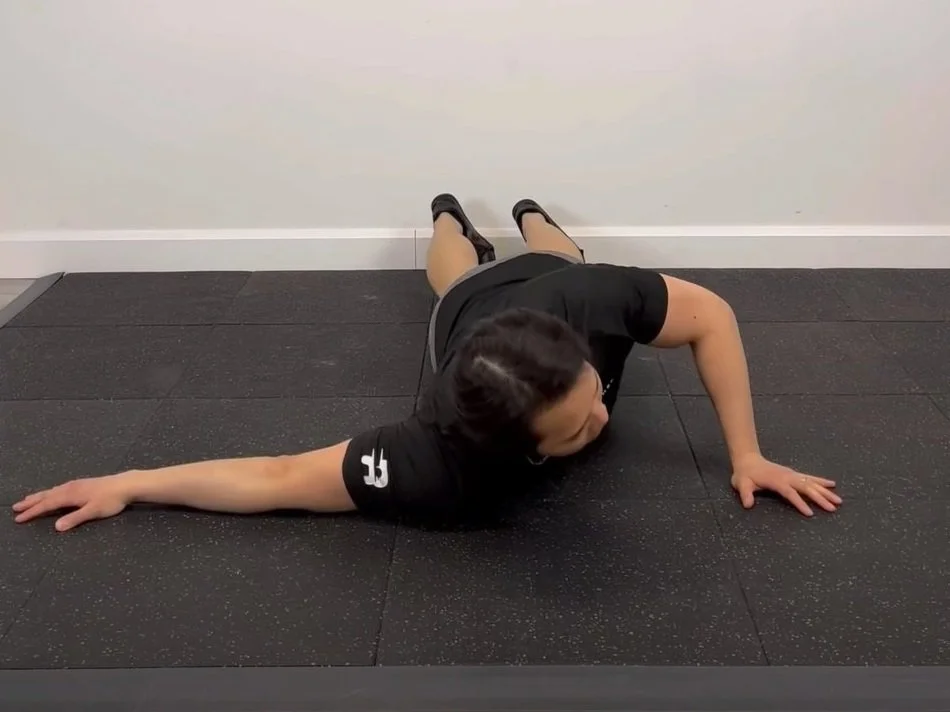
6. Prone T-Stretch (Floor Chest Opener
A lying-down variation that uses gravity to your advantage and allows for a deep, relaxed stretch.
Lie face-down on the floor. Extend both arms out to the sides, palms facing down, forming a T-shape with your body. Slowly roll onto your right side by pushing with your left hand. Bend your left knee and place your left foot on the floor behind you for stability. Let your right temple rest on the floor.
As you settle in, you’ll feel a long, deep stretch running through your right chest and shoulder. For a more intense version, extend your left arm toward the ceiling. Hold, then repeat on the other side.
How Often Should You Stretch Your Pecs?
For maintenance, stretching the pecs 3–4 times per week is sufficient. If you’re actively working to correct rounded shoulders or reduce chronic chest tightness, daily stretching will accelerate your progress.
The ideal time is after exercise, when the tissues are warm and more pliable. That said, the best time is ultimately whenever you’ll actually do it — mid-morning, during a lunch break, or as part of a wind-down routine before bed.
Consistency over intensity. Showing up every day with a moderate, sustained stretch beats an occasional aggressive one.
Don’t Miss: Client EXT:ASP – Building the Architecture of Trust Before the First Login
Pec Stretching and Posture: The Bigger Picture
A pec stretch is not a standalone fix. Tight pecs are almost always paired with weak, lengthened muscles on the opposite side — specifically the rhomboids, middle and lower trapezius, and serratus anterior. Stretching the front without strengthening the back is like loosening one side of a tent without staking down the other.
For lasting postural improvement, pair your chest stretching with pulling exercises: rows, face pulls, band pull-aparts, and scapular retraction drills. This creates balance between the front and back of the body and allows the postural corrections you make with stretching to actually hold.